





For over two decades, the .ics file has been the unsung hero of digital organisation. It created a simple, functional bridge that allowed brands and publishers to provide a helpful service to their community. It was reliable, functional and, for its time, revolutionary.
But as time has moved on, audience expectations have evolved. Today, people no longer want a snapshot of information frozen in time. They expect experiences that update automatically, adapt to their needs, and remain useful long after the first interaction.
In a world of real-time expectations, the humble .ics file has become a digital dead end. It’s still OK for one-off functions, like adding a restaurant booking perhaps. But if there’s an ongoing relationship to have with a customer, it’s not suitable.

The Problem with “Static” in a Dynamic World
The fatal flaw of a static .ics file is that it stops working the moment it is downloaded. Once imported into a calendar, your connection to the audience is severed.
Real-world schedules are fluid. Start times move, venues shift, and broadcast links update. Yet, the static entry remains stuck in the past. Because .ics files are one-way streets, they cannot reflect a postponement, a cancellation, a change in details, or update a broken ticket link.
For brands, this creates a trust gap and performance risk. When a customer rocks up at the wrong time because their calendar hasn’t updated, you lose more than attendance – you lose credibility and respect. They were designed to distribute dates, not to sustain a relationship.
See how our customers are moving beyond static files to power their digital calendars →
The Solution: A Living Connection
This is where the narrative shifts. At ECAL, we reimagined the calendar as a personal, high-performance communications channel that bypasses the noise of traditional digital feeds. More than 400 leading brands across various industries have already recognised that the calendar is the most specific, relevant and effective space for a user to plan and manage their time. By evolving from a static file to a dynamic subscription service (free for users), one’s life schedule becomes a smart, living, dependable resource.
Smart Business Logic and Fast Sync
The power of dynamic calendars lies in intelligent automation. Using proprietary ‘Fast Sync’ technology, ECAL ensures event updates are delivered quickly and reliably across all major calendar programs. This allows brands to apply smart business logic at a global scale to deliver some pretty cool outcomes.
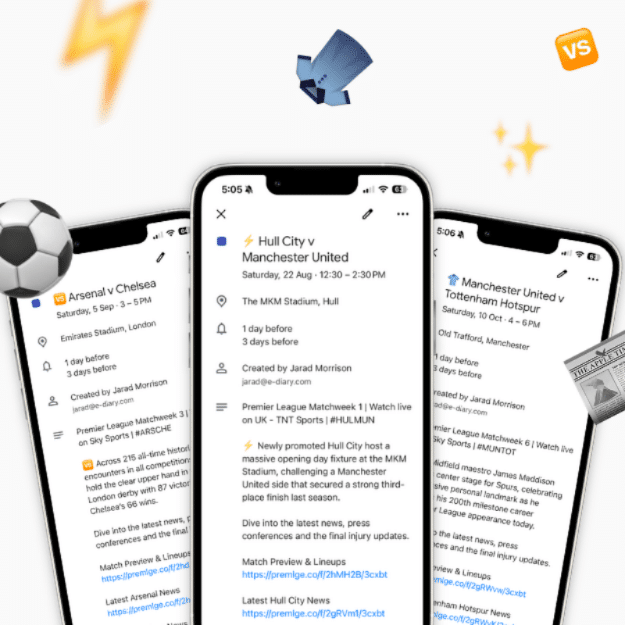
The Premier League is the definitive example. With fans across 248 countries, a one-size-fits-all schedule is impossible. Through ECAL, a fan in Melbourne receives match information at exactly the right time, with local broadcast info and personalised links, while a London supporter sees the same fixture enriched with in-market alerts and ticketing information. Similarly, Harrow Council in the UK uses custom logic to manage bin collection dates, specific to your known street address, and automatically updating for public holidays and other ‘one-off’ events, to deliver a reliable, genuinely helpful community service.
Hyper-Personalisation and AI Translation
ECAL’s AI-driven infrastructure allows brands to deliver local experiences without the operational burden. Our world-first ‘Native Language Translations AI’ automatically presents event details in the user’s preferred, detected language, whether they follow Chelsea Football Club from London, Delhi, Riyadh or Tokyo.
Beyond translation, the system uses Smart Alerts and Engagement Drivers to prompt consumers at the moments that matter most. This might be in the form of Home Game Ticket Alerts, Predict the Score promotions pre-event, or Scores & Highlights post-event. This relevance is why ECAL sees average click-through rates of over 5%, far outperforming traditional digital channels.
A Connection Built on Trust
Unlike calendar invite spam, ECAL operates on a strictly permission-based model. Every calendar subscription is initiated by the user, who retains total control via their calendar and our ‘Manage My ECAL’ portal. You aren’t fighting an algorithm; you are an invited part of their day.
The shift from static to dynamic is a move from logistics to loyalty. The .ics file played its part in the early internet era, but in a world of real-time expectations, the future of the calendar is a living connection to effectively manage time.
The Strategic Advantage
In today’s cookie-free world, where personalisation is paramount, the need to know your customer better cannot be underestimated. There is a major benefit available for brands and publishers keen to collect first-party data and behavioural insights.
The .ics file played its part in the early internet era, but for consumers that demand relevance and personalisation in a world where time and attention is precious, the future of the calendar is a living, loving connection.
Ready to move on from static files? Speak to an ECAL expert to transform your schedule into a high-performance engagement channel.


